
Enter the Osa: Magnificent Mangroves
Our time staying at Toucan Valley had provided us with the space and opportunity to make a number of decisions. Happy with the place that we had booked for our return to the UK, we were optimistic about having that time in a new place before we went back to our own home. That was looking further into the future but sometimes it helps to know where you are heading for to help plan your route along the way. Costa Rica is full of microclimates and various ecosystems and one that we had not yet visited was the mangroves; it’s a rich and unique ecosystem and the mangroves at Sierpe are one of the largest and most diverse on the whole planet. With that in mind we had booked ourselves a few days stay and a tour. After a bit of of research and deliberation we made the decision to stay in Palmar Sur rather than in Sierpe itself. There were not a lot of options in Sierpe plus we had learned by now that it is often far more important to be nearer to amenities and make excursions rather than the other way around.
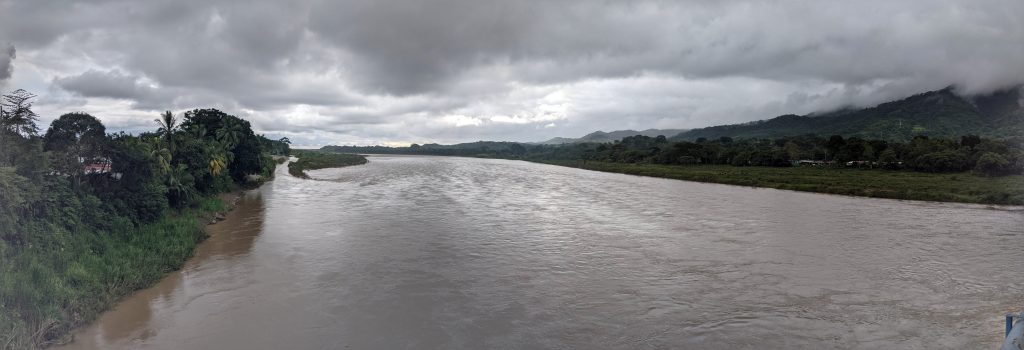
Back at Toucan Valley Jonathan finished up his excellent hosting by arranging another 4×4 taxi to take us down. Once again we experienced the huge changes that are possible moving such a short distance here; within 20 minutes we went from the relative cool of the mountains to the baking heat and humidity of Palmar Sur. We entered via Palmar Norte which is separated from Palmar Sur by the Rio Terraba; a wide and murky river which sprawls and meanders between the two. When I crossed it on foot later that day to go and fetch a few essentials I was hoping that I might catch a glimpse of a crocodile as it looked like a likely spot but didn’t see any. All of the shops and amenities are in Palmar Norte which is not exactly a busy place but there is a lot of through-traffic going along the main route there. Palmar Sur, by contrast, is a very sleepy little place which has the feel of a tight-knit community. Our place was on a little side road just next to the football pitch. Through most of Saturday there were matches taking place and it seemed as if the whole community were gathered in the metal stands to watch; passing the day with picnics and children playing in the shade below. Ours was one of only a handful of places to stay and generally it felt like somewhere that tourism has so far had minimal impact. Just along the road from where we stayed there was a park which had large stone pre-columbian spheres dotted around. There wasn’t a lot of information about the origin of the spheres other than they ranged in size from ‘a few centimetres’ to 2.66 metres, dating from around 400 BC. As with many of these ancient artefacts much is left to the imagination to wonder how they were transported, what was their significance and to marvel at the craftmanship and skill which was required to make them.
Another highlight for our short stay in Palmar Sur was that we had another exemplary host. As soon as we arrived we heard from Norling who made clear that he would be available for anything that we needed. Shortly afterwards we received a message from him telling us that his sister was on her way with some gifts for the children! A few minutes later she arrived and we received 2 camping cups for the girls, each with a picture of a sloth which was a theme he had adopted for the house. The following evening she came by with a serving of Pejibaye for us as she had just cooked up a batch that day. In general, we have found our Costa Rican hosts to be incredibly helpful and hospitable throughout.
Our first day there was peaceful. Taking a couple of walks out to explore the local park, we amused ourselves following the extensive trails of leafcutter ants who work tirelessly to feed the colony. They are always fascinating even after so many months of seeing them everywhere we go. The trails are a two-way system and it’s easy to see that there are ants travelling towards the nest carrying leaf-cuttings, and the other side is those who have already deposited their load and are making their way back to collect some more. The example the ants have to offer seems to be that they are all gainfully employed in the essential tasks needed for their survival – collecting food, maintaining the nest and raising the next generation. I’m not sure that I would suggest that we limit human culture to the same bare minimum and deny ourselves the cultural richness and variety of life that we have developed over the millennia but I do often feel that perhaps the scales have tipped too far the other way and that reconnecting with the fundamentals would probably benefit human society as a whole and improve the health and well-being of most individuals.
The big event that had brought us to Palmar Sur was our mangrove tour which we had booked for Sunday morning. We took a taxi along to Sierpe which was about a 20 minute drive. Along the way the most noticeable feature of the landscape was that it is entirely dominated by palm oil cultivation. Passing by the repeating rows of oil palms it was possible to spot signs naming it as the property of ‘Palma Tica’ which we found out from speaking to a few of our drivers to be the principal producer of palm oil in Costa Rica. One interesting side note was to observe what these plantations look like as you pass them. The information that we receive back home is that these are huge monocrops wreaking havoc on the landscape. I have no intention of negating that view or of defending palm oil cultivation but rather to add a little nuance based on my own observation. Whilst they are indeed a ‘monocrop’ they are not in the same league perhaps as something like oil-seed rape or wheat. What I mean is that those crops exist to the total exclusion of any other plants and maintain a layer of bare soil in and around the singular species being cultivation. This is because they are replacing the herbaceous layer within the landscape. Palm oil is more aptly compared to an orchard. It is a monocrop in the same way that rows and rows of apple or cherry trees are but because it occupies the canopy layer there is still room for a herbaceous layer to establish beneath it. That layer here in the tropics is far more diverse than the equivalent layer of vegetation back in Europe. Again, my intention is not to defend this system in any way but just to balance how it is represented. It should also be noted that in the places where palm oil cultivation continues there is scope to improve it by making better use of the herbaceous layer which naturally occurs beneath. To further balance this view it should go without saying that the diversity in such a system is a fraction of what was there before and of what exists in the surrounding rainforests which remain intact.
We arrived at Kokopelli Tours which Rachael had decided looked like one of the best in Sierpe. A short wait while they got the boat ready was a welcome opportunity to make sure everyone had been to the loo before boarding! The first ones to board gained us the front seats which turned out to be a blessing at times for the view ahead of the boat but also meant that we occasionally received the full force of the sun’s heat. The boat was very comfortable and we had a great guide who knew the river and the wildlife very well. At first you could be forgiven for thinking that he had some kind of superhuman vision, spotting things in the distance and the undergrowth which nobody on board would have seen; however he did reveal that many of the animals would hang out in the same places each day. The very first thing we spotted was top of Rachael’s list – a crocodile. Admittedly it was a baby one which if anything made it even more special. It was the one thing that she really wanted to see in the mangroves so we were off to a good start. After that the sightings really came one after the next. There were lots of scarlet macaws making their way through the treetops and flying right past us. We saw a Jesus Lizard on the banks but unfortunately didn’t get to see it running across the surface of the water. There were large groups of iguanas munching their way through the vegetation on the banks as they soaked up the heat from the morning sunlight. All in a line up the trunks of the trees there were tiny bats of which we also saw larger groups nesting on the underside of a bridge. Perhaps the most frequent sighting throughout the tour were the various species of monkey. To begin with we saw mainly groups of Squirrel Monkey and Capuchin. These were the most animated groups too, often playing in the trees by the side of the riverbank. We were lucky to see them using their ‘monkey bridges’ which are crossing points that they use where the tips of 2 trees meet, giving them safe passage over the water. They would also come right down to the river at times and put their tails or arms into the water and then retreat back along a branch to drink the water from their fur!
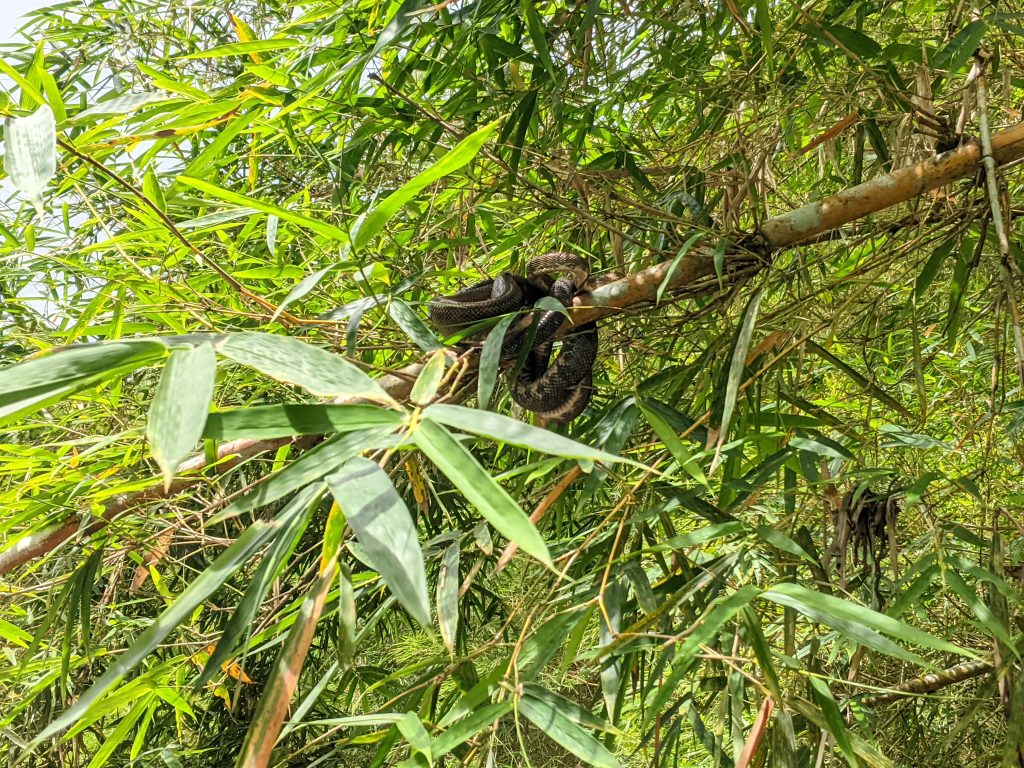
One of the harder animals to spot were the snakes as they are so well camouflaged and also hardly ever move; this latter characteristic also meant that our guide could frequently find one which had remained in the same spot for the past few days.
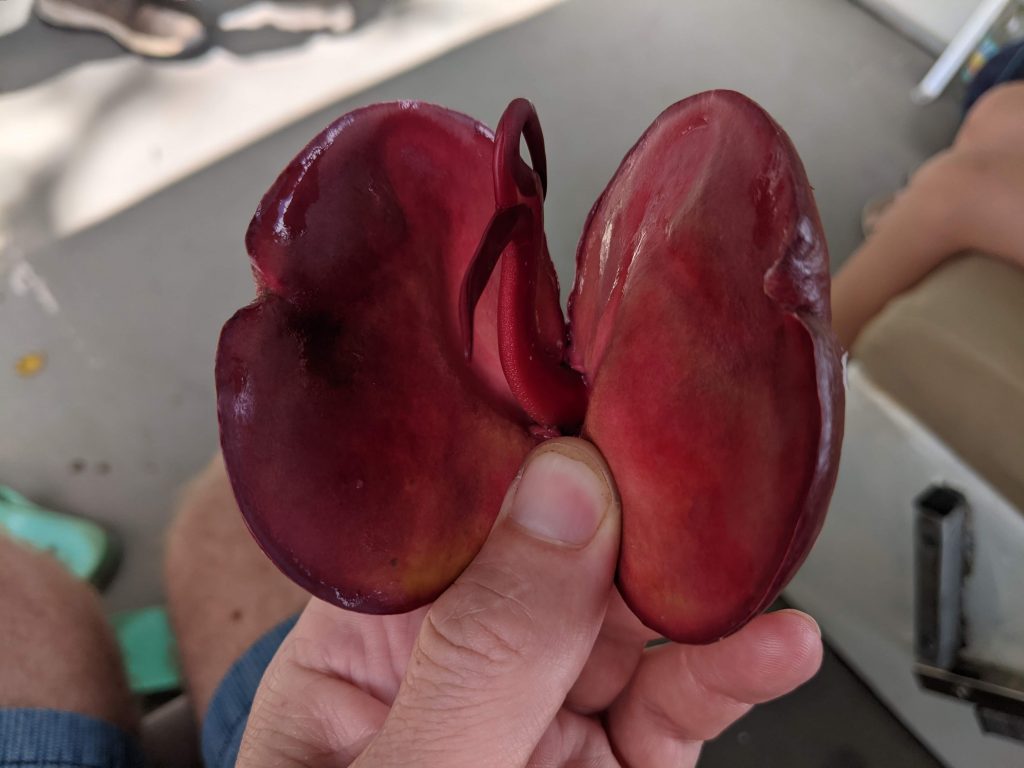
After almost 2 hours making our way along the waterways we turned about and started our return. This time we were moving a lot faster providing everyone on board with a welcome breeze. Every now and then we did need to slow down so that the boat could navigate its way past one of the many enormous clumps of bamboo which had come to dominate a lot of the banks and would eventually fall into the water. When we first set off it had been high tide and now that the tide was making its way out we went back past the point where we began to see more of the mangroves. Our guide told us about the 4 different species which make up the majority of the mangrove and we even got to try a little of the sweet juice from within one of the seeds. These seeds often look like a bird when opened up and they are something that we have seen throughout our time on the beaches of Costa Rica.
The final highlight was a search for more crocodiles now that the tide was low enough that they would likely be basking on the banks. Unlike the baby that we had seen at the beginning these were really big crocodiles!
One thing that we found on our tour and perhaps throughout our visit to Costa Rica is that it’s often not worth getting your camera out unless you have a really good one. The animals which seem to be so close really don’t get captured without a powerful zoom lens and the pixelated pictures that you find when you get back home are generally a disappointment. In most cases you’re better off not bothering and just enjoying the moment.
All in all the tour had been a success and we were really glad to have made the journey down as far as we did. Our guide told us that after going on the tour in Sierpe it might not be worth continuing as far as Corcovado which was not something that we were thinking to do anyway. The reality is probably that it’s pot luck what you get to see in each place. Much of the wildlife that we saw we had seen elsewhere but if you want to see a lot of different species in a very short time period whilst also enjoying a beautiful boat ride then this is a fantastic way to tick off a large portion of the huge number of species present in Costa Rica. We finished up glad that we had at least made it into the Osa Peninsula and experienced a little of the richness that this region holds. Maybe in the future if we return with the girls a little older we’ll get to explore more of this biodiversity stronghold.
Leave a Reply