
Atenas: The Most Perfect Climate on Earth?

After our stay at the condominium our adventure was taking us up into the cloud forests of Monteverde and then on a trip around Lake Arenal. However, we had one more stop to make before beginning that chapter. The journey from Santa Ana all the way to Santa Elena (near to Monteverde) would have been a very long car journey and we decided to break it up with another stop halfway. As luck would have it halfway would take us to a little place called Atenas which has gained a small claim to fame for having the most perfect climate on Earth. That was enough to arouse our curiosity and as we needed to make a stop anyway we settled on a nice place on the outskirts. Our plan was to have somewhere to do very little for the week and for that week we increased our budget a little so that we could have somewhere with a pool for the girls to enjoy.
We were very fortunate to stay in this house as it had just been sold and the buyer was due to move in the day after we finished our stay! It was a really nice house; however we’ve noticed a strange curve with moving house constantly. On first arriving we’re usually impressed but that’s partly the relief of having the journey over and done. Then as we look around we spot a few things that are a bit of a disappointment and usually on the first day we end up feeling like we’re not as happy with the place. I think that we’ve now realised that this has more to do with moving from one place to the next than with the actual house because by the end of our stay we really like wherever we are and feel slightly reluctant to leave – a week is about how long it takes to begin to feel settled.
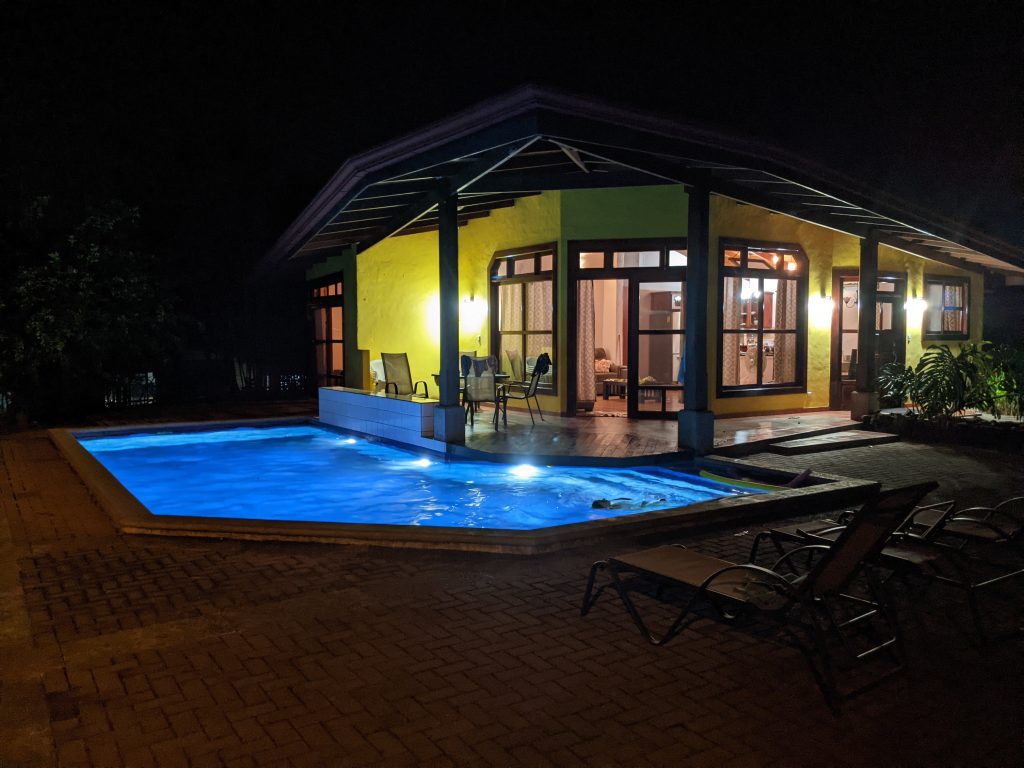
We were in another gated community but this one felt very different as the houses were all quite large with big gardens and so they really felt like detached houses. The only shared space was the entrance gates and the communal bins by the gate. This was good though as we had the pool and the girls were able to really enjoy the privacy. It’s fair to say that Zia spent pretty much all day every day in the pool. It was great because her confidence in the water and her swimming came on immensely in that short period of time; in 7 days she gained much more confidence from being constantly in the pool than from months of swimming classes back home.
Once settled we needed to get some food and we caught an uber down into the main town which was about a 10 minute journey. First we stopped off in the town centre and after buying an ice-cream we went to sit in the plaza. It had a good feel about it with loads of green parakeets coming in to roost for the evening chattering overhead. We also heard but could not see an Oropendola, easily recognising its call thanks to hearing it over and over again when my phone received a notification! From there we went in search first of all for a ‘green market’ which we’d found on google maps but as we’ve often found to be the case it didn’t exist – presumably it had been there once but the listing still remained after it had closed down. A little sad that we hadn’t found somewhere to buy some fresh produce we carried on along the road to the local Coopeatenas which was a supermarket but was a cooperative and so the fresh fruit and veg was at least coming from local suppliers who were getting a better deal for their produce.
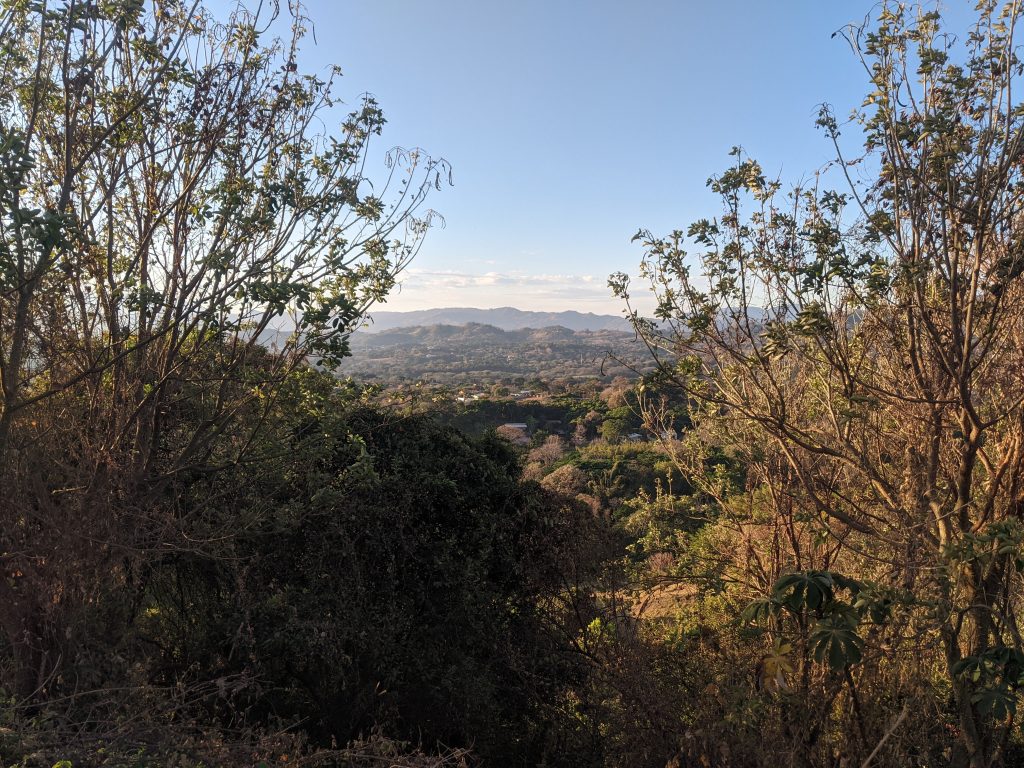
The week in Atenas was on the surface fairly uneventful with us spending most of our time around the house we were renting. However, the week was also very eventful because we made some big decisions. We had been trying to think ahead to what we were going to do when we reached the end of our 3 month visa. During our stay at Finca Las Koalas, Sophia had asked Rachael if we would be interested in looking after the farm for a while because she needed to go overseas. We’d been mulling it over for a few weeks and with the time and space that we had in Atenas we decided that it was something that we would really enjoy. We’d spent a good couple of months moving around and the thought of being based in one place for a while really appealed to us. This was even better than just a longer stay because we would be getting to look after the farm, involving ourselves further in the local food system and gaining some really useful insight into how it felt to be doing that in the tropics. Additionally, the farm was working on permaculture principles and we were really drawn to being able to make a positive contribution to the land once again. So we called up Sophia and started to make our plans. It was really exciting!
I also enjoyed the space that we had to join a couple of the community calls on the Earth Regenerators network. I remember one very clearly because we were talking about interaction with place and what kinds of things people could be doing in their bioregion to make a contribution. For us this felt tricky because on the one hand we have left the bioregion with which we are familiar and the social networks embedded within our community. However, here in Costa Rica there also seemed to be connections forming. Within the network on ER there had been gathering momentum around a bioregional project based in the Osa Peninsula in Costa Rica. The Osa contains 2.5% of global biodiversity. If you look it up on a map you’ll see it’s a relatively small land mass which makes this 2.5% really staggering and highlights the importance of preserving the area. With our stay at the farm in our sights we were going to be fairly close to the Osa and so at least we were able to look at how we might be able to connect in the future. Through my friend Pamela on the ER network I had also been put in contact with her friend Gary who was also visiting Costa Rica with his family. During that week I managed to have a call with Gary and share some of our experiences here so far as well as seeing how we might be able to connect in the future. I remember that the specific call that I was on that day finished with somebody telling their story of how important it was to them to walk a place whenever they arrived there so that they could get to know and understand the landscape. A seed had been sown.
That seed germinated not through any care on my part but really as a result of necessity. One morning I got up early knowing that we needed a few things again from the Coopeatenas. Initially, I checked on uber but there were no cars available for at least 20 minutes and often it takes longer to arrive than the app predicts. Add to that the 10 minute drive and I decided that I might as well set off for the walk which google maps predicted would take around 40 minutes. I was so glad in the end that I hadn’t been able to find a car. It wasn’t a beautiful walk as I was following the main road into Atenas and frequently having to watch out for cars whilst dodging stray dogs along the way. I was however getting to know the landscape in a different way; it was extremely hilly! Steep slopes took me up and down the surrounding hillsides giving my legs a good workout. About halfway along I started to pass cars which were backed up in traffic. As it turned out the traffic at this time of day was really heavy which was why I had been unable to find a car in the first place. Amusingly, I was travelling faster on foot than the people sitting in their cars! If I had caught an uber then in addition to the 20+ minute wait for it to arrive I would have ended up sitting in that same queue of cars and the journey would have taken longer than on foot. It also felt really good to get out and about so early in the day.
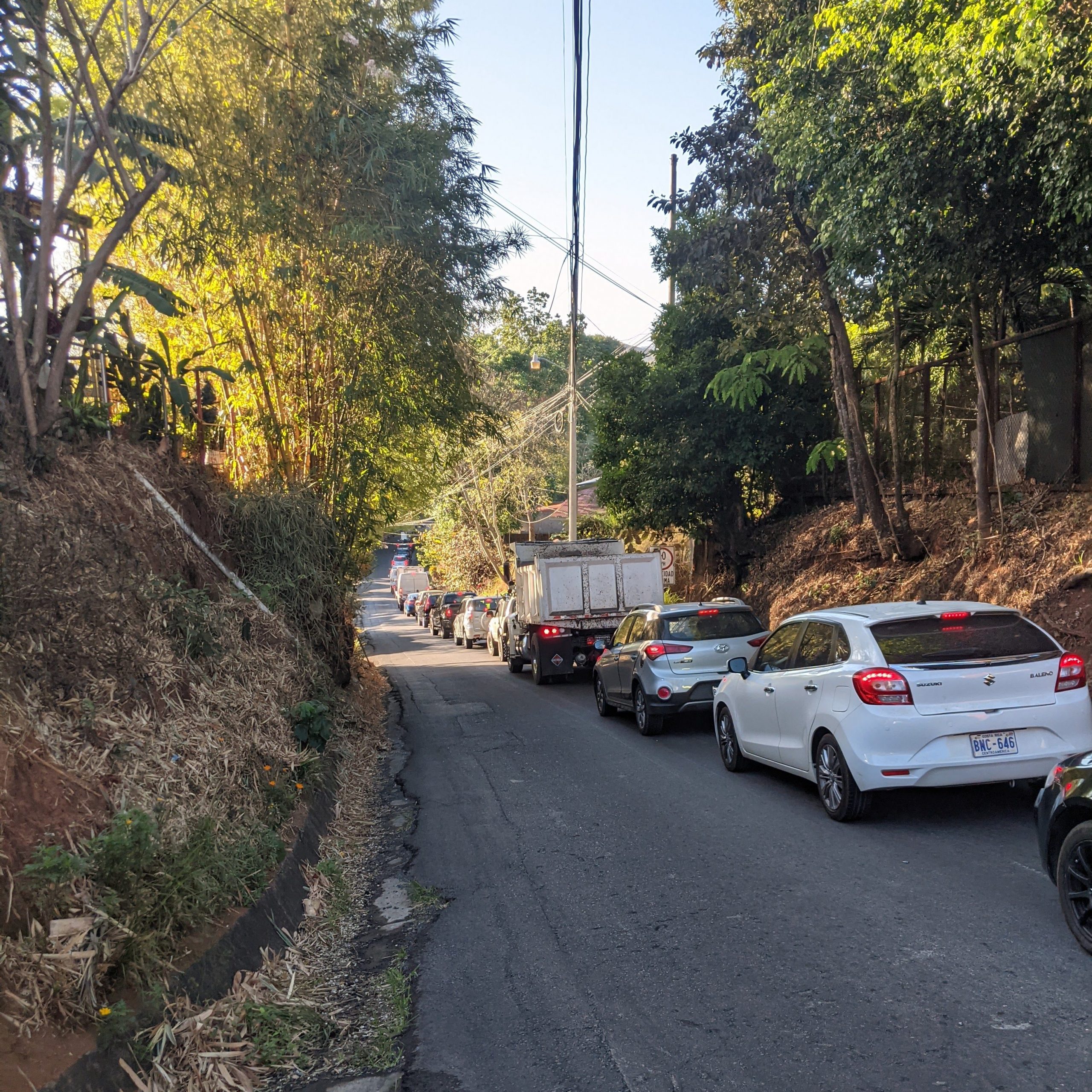
That chance walk to the shops a few days into our stay was the happy accident that led to me getting up early every other day and heading off in different directions to explore. The land surrounding Atenas (and a lot of other places in Costa Rica) is made up of mountains. There are steep winding tracks all around. Walking these roads reminded me that the motor vehicle has all but erased this understanding of a landscape; you only need to press your foot down an inch or so to climb those inclines in a car in contrast to the effort required to cover them on foot. This got me thinking about how this affected patterns of settlement.
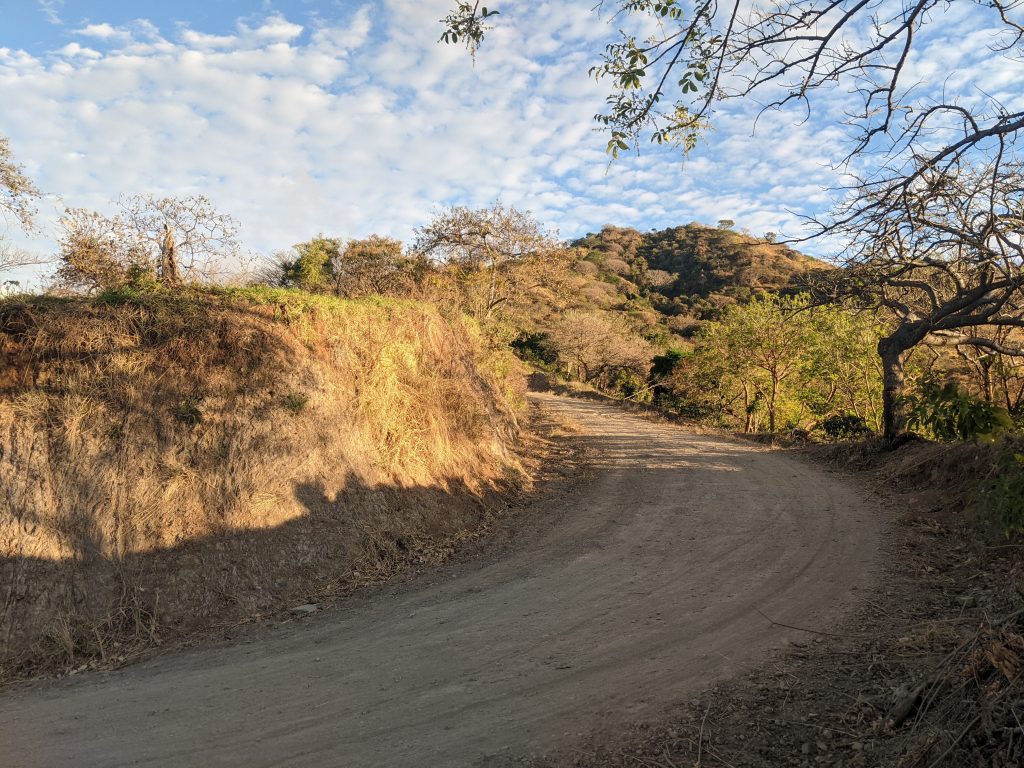
One morning as I set off for my walk up the hillsides that overlooked our house I travelled along a road which was still in the process of being made. As I made my way along the road and up the hill I noticed that even as I got to the highest points there were a couple of houses. There is a pattern of this type of settlement here; finding a hilltop (with a great view of course) and building a house at the very top of it. Before the arrival of cars this would not only have been impossible but it would have been undesirable. To be so removed from the rest of humanity either requires a very high level of self-sufficiency or else it requires a way to transport food, fuel, materials etc. up to those remote locations. This got me thinking about the kinds of settlements that the landscape would have required before the motor car. Being at the top of those slopes would mean exactly the same thing – that either as a community you would need to be self-sufficient or else you would have to cart goods up and down on a regular basis. Other than security (being able to see people approaching) it left me wondering what motive, if any, people would have for living high up? I think that it would be far more likely that settlements would have been in the lower ground, perhaps also allowing access to waterways. Of course one other factor to keep in mind when surveying this landscape is that although now it is possible to climb those hills and survey the landscape, that is a very modern feature; they would once have been covered all over in dense tropical forest and it’s interesting to think as well about the patterns of settlement that would have created. I think it’s fair to say that none of it would have been anything like the Costa Rica that we look over now. When I think about not only climbing and traversing this landscape solely on foot but it also being covered in dense vegetation it really makes my mind boggle to think what it means for landscape to dictate human habitation.
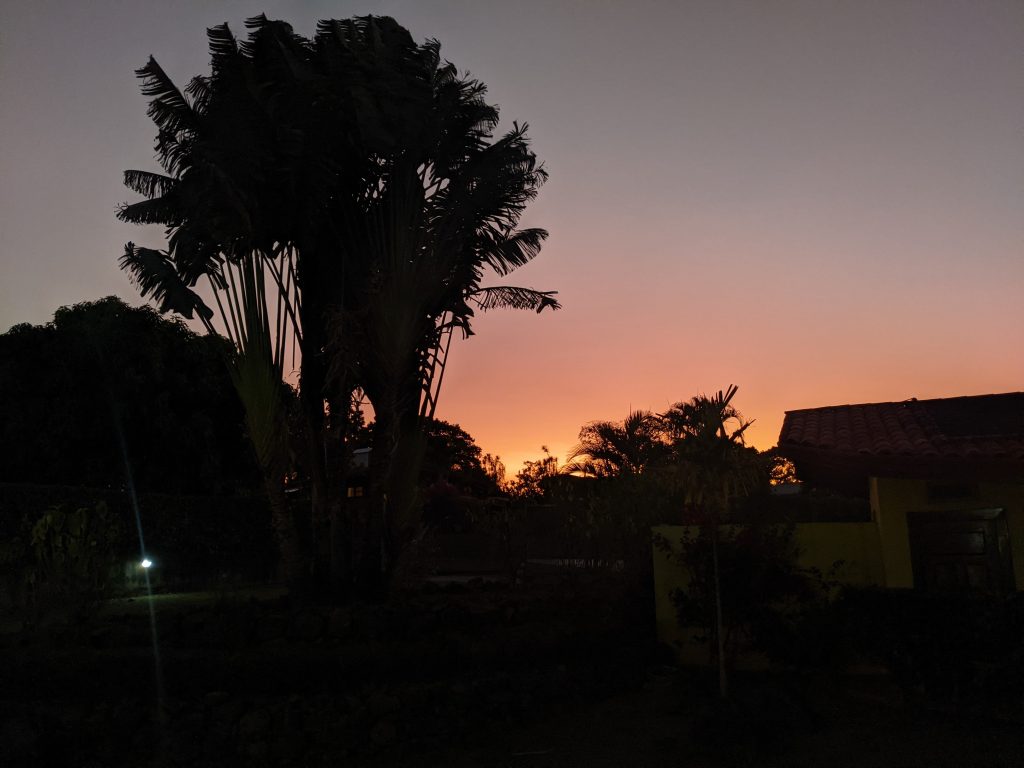
I’d like to finish up by bringing these thoughts full circle. We were brought to Atenas by circumstance and curiosity about the ‘perfect climate’. I think we felt it was a bit too hot actually. The mornings were glorious and the evenings warm and balmy but the middle section of the day was a little bit too much. Here in Costa Rica, in the tropics and so close to the equator, altitude is a huge factor in determining climate. I think that for me personally Atenas could do with lifting up just another couple of hundred metres! Of course it’s all subjective anyway. We should also remember that the climate there now is radically different to what it would have been when it was all still forested.
Now we were gearing up and getting ready for our visit to the cloud forests of Santa Elena and making our trip around Lake Arenal and down towards the Volcano…
3 Comments
Loving all these posts and reading about your journey!! I loved Monteverde and can’t wait to read about your perspective!
Thanks Monica! Glad you’re enjoying it and thanks so much for following our journey. Hope that you continued to enjoy your travels after we met as well!! Should finish writing up Monteverde this week and hopefully some more after that too.